Where Rannscape Begins

Rannscape Weaves is a premium textile house built on a single conviction: cloth made with devotion carries something no machine, however precise, can replicate. We work directly with the master weavers, block-printers, and artisan communities of Kutch, Gujarat, a region where the harshest terrain in India has, for centuries, produced some of its finest handloom traditions.
Everything we make begins with Kala Cotton, a short-staple, indigenous cotton native only to Kutch. It asks almost nothing of the land. No irrigation, no chemical inputs, thriving on rainfall alone in a climate that would defeat most other crops. We were drawn to it for what it says about resilience: that the most enduring things are often the ones that ask for the least.
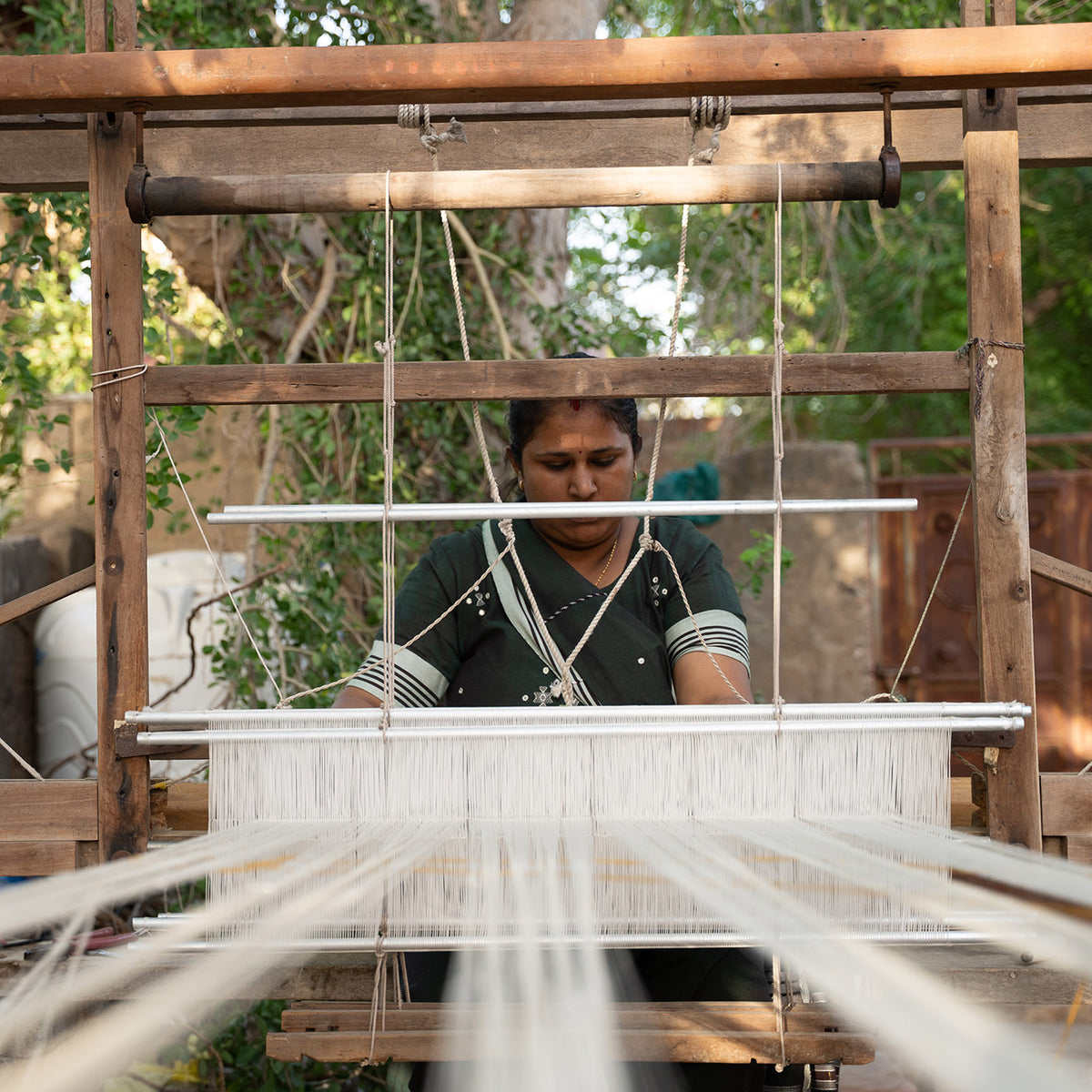
From that fibre, our weavers build sarees, stoles, and suit pieces on traditional pit looms, each thread placed by hand, each pattern the result of decisions no machine is capable of making, like tension, rhythm, and intention. Whether we work with Ajrakh block printing or Kutchi embroidery, the same principle holds: techniques carried across generations, too intricate and too slow to rush, are worth exactly the time they take.
We are not interested in scale for its own sake. Rannscape Weaves exists to build a different kind of relationship between a maker in Kutch and someone, somewhere in the world, who understands that what they're wearing has a name, a village, and a story behind it.
Vision & Mission


Vision
To establish Kutch as the world's most trusted custodian of sustainable, hand-woven luxury where artisan empowerment, ecological stewardship, and cultural pride intersect.
Mission
We elevate the Kutchi textile ecosystem by directly partnering with master weavers, honoring their craft through fair compensation, sustainable practices, and global recognition. Every piece tells a story of heritage, artisanal skill, and ecological commitment.
Founder's Story

Rannscape Weaves was founded by two people who arrived at the same place from opposite directions. Juin Majethia grew up in Bhuj in a household of Ayurvedic practitioners, where nothing was wasted, and cloth was chosen with the same care given to everything else; her formative years in Dharwad, amid the rain-soaked forests of the Western Ghats, taught her the same truth in an entirely different register: that being held by the earth has nothing to do with geography. Nihit Vyas also grew up in Bhuj, in a family descended from priests at an ancient Kutch temple, before spending twenty years building a career in Australia, where the bush and its deep Indigenous relationship with land quietly undid his sense of what "success" was supposed to feel like. Kutch shaped them both. It simply took each of them a different route back to it.

What brought them to the same conviction was the discovery of the same discipline in two very different professions. Juin spent twelve years as a dentist, practicing Conservative Dentistry by surveying what to preserve, what to remove, always in devotion to the original form, before recognizing that same patient, unhurried attention in a Kutchi weaver's hands, thread by thread. Nihit found it too, sitting with a weaver outside Bhuj who described losing all sense of time at the loom, a state Nihit knew intimately from his own meditation practice, and named precisely in Zen philosophy as mushin, no-mind, the self dissolving into the act. Both had spent years mastering exacting, modern professions. Both found, in the loom, the same devotion they'd been practicing all along.

Rannscape Weaves is the bridge they built together, between Juin's understanding of Shringaar and Nihit's conviction that fast fashion is a wound disguised as convenience, and slow fashion a conversation between a human being and the earth. Every piece is handwoven by a named artisan in Kutch, using organic and traceable fibers, Kala Cotton chief among them, grown and spun the way it has been for generations. Two founders with two very different paths and one shared understanding that "cloth made in devotion carries something no machine-made thing ever will, and that the world had simply forgotten how to ask for it.